
TL;DR. A fund expense allocation policy has to name what each fund may bear and under which clause, the basis behind every expense type, the caps and who holds the running balance, side-letter overrides and where a shortfall lands, who approves a rule, and how the policy changes. The twelve-component outline below is complete.
Why is the LPA not the policy?
Because the agreement was drafted to survive a negotiation, not to settle a Tuesday afternoon. The person who runs finance at a large venture firm put the gap exactly.
Although that sounds very simple on paper, in practice, it's very gray.
Every partnership agreement defines partnership expenses differently, usually as costs incurred in pursuit or support of portfolio companies, and the vagueness is often deliberate. Nobody knows whether a cost can be charged, so everybody combs through the agreement again, which is what happens every quarter-end at a multi-billion-dollar private equity firm running funds up to twenty years old.
Instead of a policy, firms have an inventory. Compliance keeps a cheat sheet with no master grid, agreement references sit as notes in the allocation spreadsheet, and the controller keeps his own slide deck holding his reading of the language. At one private equity firm the rules are not in a document at all. They live in the controller's memory and a set of spreadsheets spanning funds written twenty years apart, and when a question arrives that the agreements do not obviously answer, he asks a chatbot. The firm runs a quarterly expense meeting with the CFO and the chief compliance officer, which is the closest thing to a policy review it has, and when the language is unclear the management company absorbs the cost, which is a decision nobody wrote down.
The reason to write it down is not neatness. The gap that gets found is between the policy as written and the allocation as performed. Our view is that an unenforced policy is worse than none, because it documents the standard you failed to meet. That is also the shape of what an examination tests, covered in our piece on SEC exam findings on expense allocation.
A fund expense allocation policy is the written rule set that decides which entity bears each cost. It records what the fund documents permit each fund to bear, the basis used for every expense type, the caps in force, who approves a rule, and how each decision is evidenced, so two controllers reading the same invoice reach the same split.
What is a fund expense and what is a management company expense?
Fund expense vs management company expense. A fund expense is a cost the LPA permits the fund to bear because the work benefited the fund, its investments, or its investors. A management company expense is a cost of running the adviser's business, which the adviser bears out of its management fee. The split is governed by the fund documents, not by which entity the vendor billed.
The classification turns on two tests, set out in full in our research on fund vs management company expenses, which are who actually benefited and whether the fund documents let the fund bear it. Which entity the vendor happened to bill decides nothing.
| Expense category | Usual side | The test that decides it |
|---|---|---|
| Deal diligence on a completed investment | The funds that invested | Benefit, plus the agreement's expenses clause |
| Fund formation and organizational costs | The specific vehicle, up to its cap | Named in that fund's agreement, capped by vintage |
| Audit, tax and fund administration | The fund | A fund-level service the documents permit |
| Salaries, office and payroll | Management company | The cost of running the adviser, paid from the fee |
| Firm-wide software and marketing | Management company unless the agreement names it | Whether the documents permit the charge |
| Broken deal costs | Whichever the agreement says, and it must say | The clause naming them and who else looked at the deal |
The gray zone is real and it is where a policy does its work. Research and data subscriptions, technology, travel, insurance, consultants and broken deals all have a defensible answer on either side, which is precisely why the answer has to be written once rather than argued each quarter.
The three decisions most policies skip
A written policy is only as good as its answers to three questions. Most memos answer the first implicitly, the second vaguely and the third not at all.
The shortfall question
When one investor bears less than their pro-rata share, where does the remainder go? Either the management company absorbs it or it gets reallocated across the remaining investors, and the two answers produce different journal entries and different disclosure. This is the design decision that comes before everything else, and a policy that says expenses are allocated pro rata by commitment has not answered it.
Take a $400,000 consulting expense allocated across a fund's investors by commitment. One limited partner holds 25% of commitments, so their pro-rata share is $100,000, and their side letter caps them at $50,000.
| Treatment | The capped investor bears | Remaining investors bear | Management company bears |
|---|---|---|---|
| Management company absorbs the shortfall | $50,000 | $300,000, unchanged | $50,000 |
| Shortfall reallocated across the others | $50,000 | $350,000 | Nothing |
Under the second rule, an investor holding 15% of the fund holds 20% of what is left after the capped investor, so their share rises from $60,000 to $70,000. Someone has to compute the override, carry the running cap balance across the year, and book the $50,000 difference, which in the first case is an intercompany accounting entry between the management company and the fund. A spreadsheet computes the split. It does not carry the balance forward or decide where the difference lands.
The cap question
Caps are annual or life-of-fund, by category or in aggregate, per investor or per fund, and somebody holds the running balance. A controller at a large venture firm described the shape as a $2 million organizational-expense cap with $1.8 million already taken, then a $300,000 bill arriving, which puts the fund $100,000 over before anyone notices. A cap only works if the coding is right, and a vendor coding an organizational cost as a legal fee makes the ceiling meaningless. That is the failure underneath the first one. A VP of finance at a private credit firm runs a $100,000 category cap that depends entirely on the coding being right.
The effective-date question
Terms propagate after each close, and most-favored-nation clauses pull earlier investors up to later terms. So a rule needs a date from which it applies, and a log recording when it changed and who changed it.
The twelve components with the wording each one needs
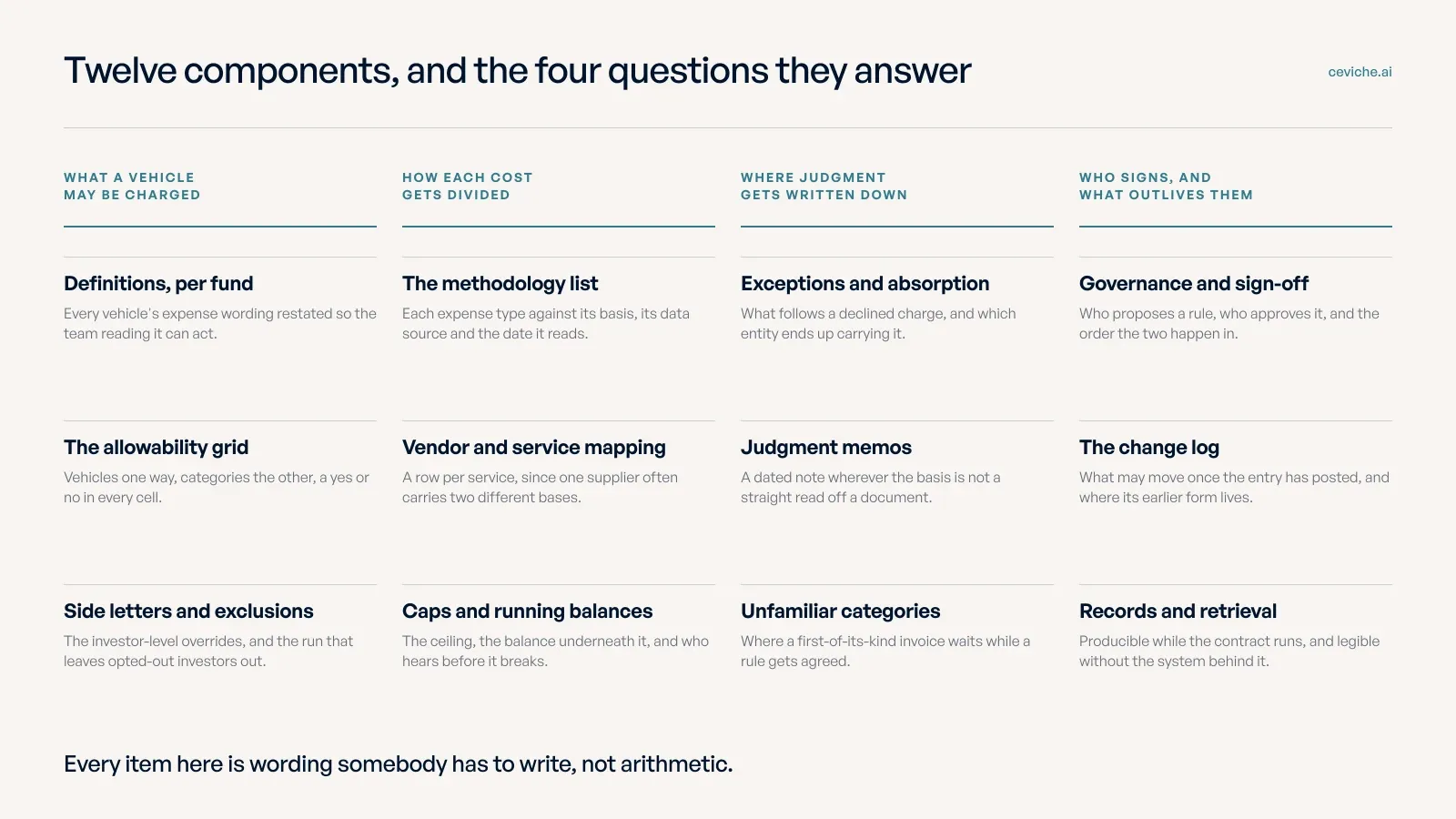
What follows is assembled from components that real fund finance teams described to us. No single firm we spoke with had all twelve written down in one place, and the example wording is ours rather than any firm's or any market standard.
1. Definitions per fund
Take each vehicle's partnership-expense definition and restate it in categories a non-lawyer can act on, with every category referenced back to the paragraph it came from. One head of finance described doing exactly that, simplifying the agreement into digestible categories because the team looked at the legal language and stopped reading.
2. The allowability matrix
Funds across the top, expense categories down the side, a yes or no in each cell, and each cell numbered to the paragraph that decides it. One adviser described a client's grid at twenty funds by thirty categories, with the allocation spreadsheet reading from it. Build this grid first. Parse every agreement relevant to allocation into a first pass covering allowability by fund and caps by vintage, then review it line by line with whoever owns compliance for those agreements. The inputs are rarely only the agreements. A spreadsheet tracking caps, or a compliance officer's long email listing what can and cannot be expensed and the diligence caps for the deal team, are part of the policy too.
3. The methodology list
Every expense type mapped to its basis, the data source behind that basis, and the as-of date rule. The bases fund finance teams actually use are invested capital, investor count, investment count, unfunded commitment, equal allocation, fair market value of investments, side-letter count, cost in fund, direct fund expense and specific investment. A reader who wants the mechanics behind each one will find them in our guide to cost allocation methods.
| Expense type | Basis | Data source | As-of rule |
|---|---|---|---|
| Diligence on a closed deal | Invested capital in that deal | Investment records | The closing date, not the invoice date |
| Fund formation | Direct fund expense | The engagement letter | The fund's final close |
| Firm-wide research subscription | Equal allocation or investor count | Entity and investor list | Quarterly snapshot |
| Shared consulting across active funds | Committed capital | Commitment schedule | Quarterly snapshot, refreshed after each close |
| Fund audit and tax | Direct fund expense | The auditor's own breakdown | The engagement period |
| Portfolio monitoring on a held position | Fair market value of investments | The quarterly valuation | The valuation date used in that close |
The as-of rule is the row people forget. A controller raised it with us directly, because a follow-on investment made mid-period means the same vendor's bill should not carry the same split it carried last quarter. Legal invoices need their own treatment, and the method for those is set out step by step in our guide to allocate legal invoices.
4. Vendor and expense-type mapping
One row per vendor per service, because the same vendor often provides two things that carry two methodologies. One venture controller keeps exactly that, an expense-type library listing every approved vendor once for each service it delivers. Another spent six months building a consistency log so the methodology used for a given vendor is the same quarter after quarter.
5. Caps and running balances
Record the cap per fund and vintage, whether it runs annually or across the life of the fund, whether it applies by category or in aggregate, the running balance, and who gets alerted before the breach rather than after. A CFO at a small venture firm put it plainly.
Something in the background that can like ping me. That, hey, you're getting close or you've actually gone over.
6. Side letters and excluded investors
Name which funds carry investor-level overrides, and hold the separate calculation that excludes opted-out investors. One controller at a growth-equity firm keeps a standalone work paper for exactly this, recalculating the split with the excluded investors removed. The shortfall rule above belongs here, written out, with the resulting entry named.
7. Allowability exceptions and management company absorption
State what happens when a fund's advisory committee declines a charge. One controller kept the complex-wide methodology and had the management company bear the two declining funds' shares, which is the right answer because it leaves the other funds' splits undisturbed. Then require that absorbed amounts get reported to the CFO on a set cadence, because every absorbed dollar is either an accountant's error, a question for counsel, or a clause missing from the next agreement.
8. Governance and sign-off
Say who proposes a methodology and who approves it. At a large credit manager a cross-functional committee of legal, compliance and accounting approves what the allocations team proposes. At a growth-equity firm it is a weekly meeting on problem invoices with the compliance team in the room. What gets approved should be the rule, not each split it produces. Approving a recurring rule pre-approves everything that flows through it.
9. Judgment memos
For every methodology that is not a straight read from a source document, keep a dated document explaining the reasoning, on the same cadence as the close. A CFO at an infrastructure private equity firm does this for fair-value bases and for a forced management-company share where the management company has no valuation of its own, writing down why the assigned figure is what it is.
10. Reclassification and the change log
Name what may change after an entry posts and where the prior version is kept. In practice it is almost never the dollar amount. At the same infrastructure firm the corrections are almost exclusively the activity type, the expense type or the project code, never the dollars. One firm logged exactly that kind of change, moving general-partner travel from an all-funds allocation to a partial management-company share after regulatory attention increased.
11. New expense types
Set out how a category nobody has allocated before gets proposed, where the invoice sits while the decision is pending, and who writes the new language into the next agreement. At one large venture firm the first crypto-related invoice sat in an unallocated queue for a quarter or two while the committee agreed a methodology, which is slow but is the correct shape.
12. Records
State what has to be producible, in what format and at what notice, and require that the record be exportable during the term rather than only at termination and legible without the system that produced it.
Where do policies break in practice?
Three ways, and all three are about coverage rather than calculation.
The first is scope. A finance operations lead at a private credit manager running more than sixty entities described three things her written policy does not reach. The manager waives expenses for a flagship or a small fund when it chooses to, which no agreement requires and no policy records. Co-investor allocations get computed correctly and then never actually reimbursed, so the management company absorbs them by default rather than by decision. And a cost coded to the wrong account does more than misstate one line. It silently breaks the cap tracking that depends on the category being right.
The second is that the policy is not applied to every line. Of the 80 fund finance teams we spoke with in 2026, 81% still do the allocation in Excel, 63% name legal invoices among their hardest problems, and 49% have a gap in the record behind the split. A rule sitting in a document while the split happens in a spreadsheet is a rule that gets followed most of the time, and most of the time is the finding.
The third is documentation. Fee and expense allocation is a standing focus for the SEC's Division of Examinations, and what an examiner samples is the basis for a split rather than the entry recording it. That is the half our audit trail gaps data finds missing most often, and a policy is only evidence when the entry it produced points back to it.
Who approves and in what order?
The order is a policy decision and almost no template mentions it. One firm fixes the sequence rather than the formula. Compliance and the fund accounting group sign off on which entity each line belongs to before any allocation is calculated. They arrived at that order the hard way, because doing it the other way round meant booking reclassifications constantly and doing the work twice.
That sequence protects knowledge that lives in a person rather than in a rule. A compliance officer reads a vague line item, remembers the date and knows which deal it was. The policy should say who holds it and at which step they apply it, and it should count the sets of books each decision touches, since multi-entity expense allocation means every split lands as several entries plus the balancing intercompany positions.
How does the policy change and how do you prove it did?
A venture CFO we work with told us the chargeable-expenses section of his newest fund's partnership agreement grew from a few lines to about three pages, because his team detailed every granular item so there would always be a clause to point to. The policy feeds the next agreement, and the next agreement feeds the policy.
Agreements move, and the policy has to move with them. A controller at a large venture and growth firm is now writing software and artificial-intelligence language into new agreements, because the firm is incurring those costs and they benefit the funds. That is the direction the traffic should run, out of what the allocation keeps hitting and into what the next agreement says.
That is the feedback loop the policy should force. Each absorbed cost, each declined charge and each month spent waiting on counsel for whether a category is chargeable is an input to the next agreement. Record them, review them on the same cadence as the close, and hand the list to whoever drafts the next fund.
Proving the change is the other half. Every rule carries an effective date, every version is retained rather than overwritten, and the log says who approved the new version and when. A policy without a change log cannot show that the methodology in force in the fourth quarter is the one that was in force in the first, which is the question actually being asked.
Where does Ceviche fit?
The twelve components above are what we build as the expense policy matrix when a firm onboards, and the two the matrix enforces on every incoming line are allowability by fund and caps by vintage. Ceviche applies the basis each agreement specifies per line and writes the entries back to the ledger with the reasoning attached, which is the enforcement half of a policy rather than the drafting half. It is not a fund administrator, a general ledger or a managed service, and it does not do the allocations for you. Flybridge runs it across 18+ fund entities on Bill.com and QuickBooks Online. See what it does.
Frequently asked questions
What does the LPA typically allow to be charged to the fund versus the management company? Deal diligence, fund-level legal, audit, tax and administration usually sit with the funds where the agreement permits. Salaries, office costs, the firm's own software and marketing usually sit with the management company, because they are the cost of running the adviser and the fee already pays for them. Two tests decide any line, which are who benefited and whether the documents allow the charge.
How do you pick the basis for an expense type? Match the basis to what actually drove the cost. Deal work follows the capital invested in that deal, formation costs follow the specific vehicle, a firm-wide subscription follows investor count or an equal split, and monitoring work follows the fair value of what is held. Then fix the as-of date, because a follow-on investment mid-period changes the split before the next invoice arrives.
How should the last fund's actual organizational expenses inform the cap in the next agreement? Pull the actual organizational spend for the two most recent vintages, split it by category, and identify which line moved and why. Caps drift across vintages for reasons nobody records at the time, usually legal complexity or the number of jurisdictions. Bringing that history to the drafting conversation is what turns a cap from a negotiated round number into one your close can live inside.
What does the policy say when a fund expense is allowable but the fund cannot pay yet? It says the allocation and the payment are separate decisions. Allocate the line to the fund that bears it and record it, then flag the cash position so the payment routes through the management company or a subscription line as a receivable rather than being reclassified. Recoding an allowable fund expense to the management company because of a timing problem is how policy drift starts.
Who decides whether a new expense type is chargeable, and how long should that take? Whoever owns compliance for the agreements, usually the chief compliance officer, CFO or general counsel, with outside counsel where the language is genuinely ambiguous. It routinely takes weeks, and one controller waited over a month. The policy should name a holding place for the invoice while the answer is pending, so the delay does not turn into an unrecorded management-company absorption.
Where should the evidence for a judgment call physically live? Attached to the entry in your own ledger, not only in the system that computed it. A file carrying the calculation and the reasoning sits with the journal entry and stays legible after the tool that produced it is gone. Store it on the same cadence as the close, dated, naming the methodology and the person who approved it.