
TL;DR. Private equity fund accounting tracks how investor capital is raised, deployed, and returned across a fund's life, measuring accountability to LPs rather than profit. It covers capital calls, management fees, NAV and ASC 820 valuations, the distribution waterfall, and capital accounts. Most of the manual time goes to one thing: allocating shared costs across a firm's many entities.
Capital calls, waterfalls, and NAV are real mechanics you have to get right, but they are not where a controller's quarter actually goes. The week disappears into splitting one shared cost across a dozen entities, posting the intercompany entries, and defending every split when an auditor or an SEC examiner asks. This guide covers the standard mechanics, then spends most of its length on that part.
What is private equity fund accounting?
Private equity fund accounting is a specialized accounting method that tracks how limited partner capital is committed, called, invested in portfolio companies, and ultimately returned over the life of a closed-end fund. Unlike corporate accounting, which measures profit, fund accounting measures accountability: whether each dollar of LP capital was raised, deployed, and distributed exactly as the limited partnership agreement permits. The fund, the general partner, and the management company are separate sets of books, and the discipline keeps the lines between them clean. Some firms call the same work private equity accounting or investment fund accounting. The accounting for private equity investments, the quarterly marks on each holding, sits inside it.
That accountability framing is the whole reason the method exists. An LP commits to Fund III, not to the firm's office lease. A co-investor backs one deal through an SPV, not the rest of the portfolio. The books have to honor each of those boundaries, every period, in a way an auditor can verify years later. For the general background on what fund accounting is and who else uses it, see what is fund accounting.
How is PE fund accounting different from corporate accounting?
Corporate accounting answers one question: did the company make money? Everything rolls into a single income statement and balance sheet, and net income is the scorecard. PE fund accounting answers a different question across many sets of books at once: did each entity's capital stay inside the boundaries its investors and the LPA set? A management company, several funds, a GP entity, and a stack of SPVs can sit under one firm, and "profit" is not the metric for any of them.
| Corporate accounting | PE fund accounting | |
|---|---|---|
| Core question | Did we make a profit? | Did each fund's capital stay within its mandate? |
| Books | One consolidated set | Multiple self-balancing entities (ManCo, funds, GP, SPVs) |
| Headline numbers | Net income, EPS | NAV, IRR, MOIC, capital account balances |
| Who sets the rules | Management, GAAP | The LPA, plus GAAP and ASC 820 |
| Performance accrual | Salaries, bonuses | Management fees and carried interest |
| Time horizon | Annual, ongoing | The fund's full 10-to-12-year life |
The sharper difference shows up at the line-item level. A single travel or legal cost might belong half to Fund I, a quarter to Fund II, and the rest to the management company. In corporate books that is one entry in one ledger. In fund accounting it is one decision that has to land correctly in three different sets of books and reconcile between them, which is the multi-entity problem this whole discipline turns on.
What does the fund life cycle do to the accounting?
A closed-end PE fund runs on a life cycle, and each stage changes what the accountant tracks. The mechanics below are table stakes; the point is how they hand off to one another.
- Fundraising and commitments. LPs sign subscription agreements committing capital. Nothing has moved yet, so the accounting tracks committed versus called versus uncalled capital per investor.
- Capital calls (drawdowns). The GP draws committed capital as deals and expenses come due. Each call posts to the fund and to every LP's capital account pro rata.
- Deployment. Called capital buys portfolio stakes, reported under the equity method or at fair value depending on the structure.
- Holding and valuation. Each quarter the portfolio is marked to fair value under ASC 820, which drives NAV and the unrealized performance LPs see.
- Exit and distribution. Realizations return capital and gains to LPs through the distribution waterfall, with carried interest paid to the GP once the hurdle clears.
The accountant's job is to keep this internally consistent: committed capital ties to called capital, called capital ties to NAV, and NAV ties to what the capital accounts say each LP owns.
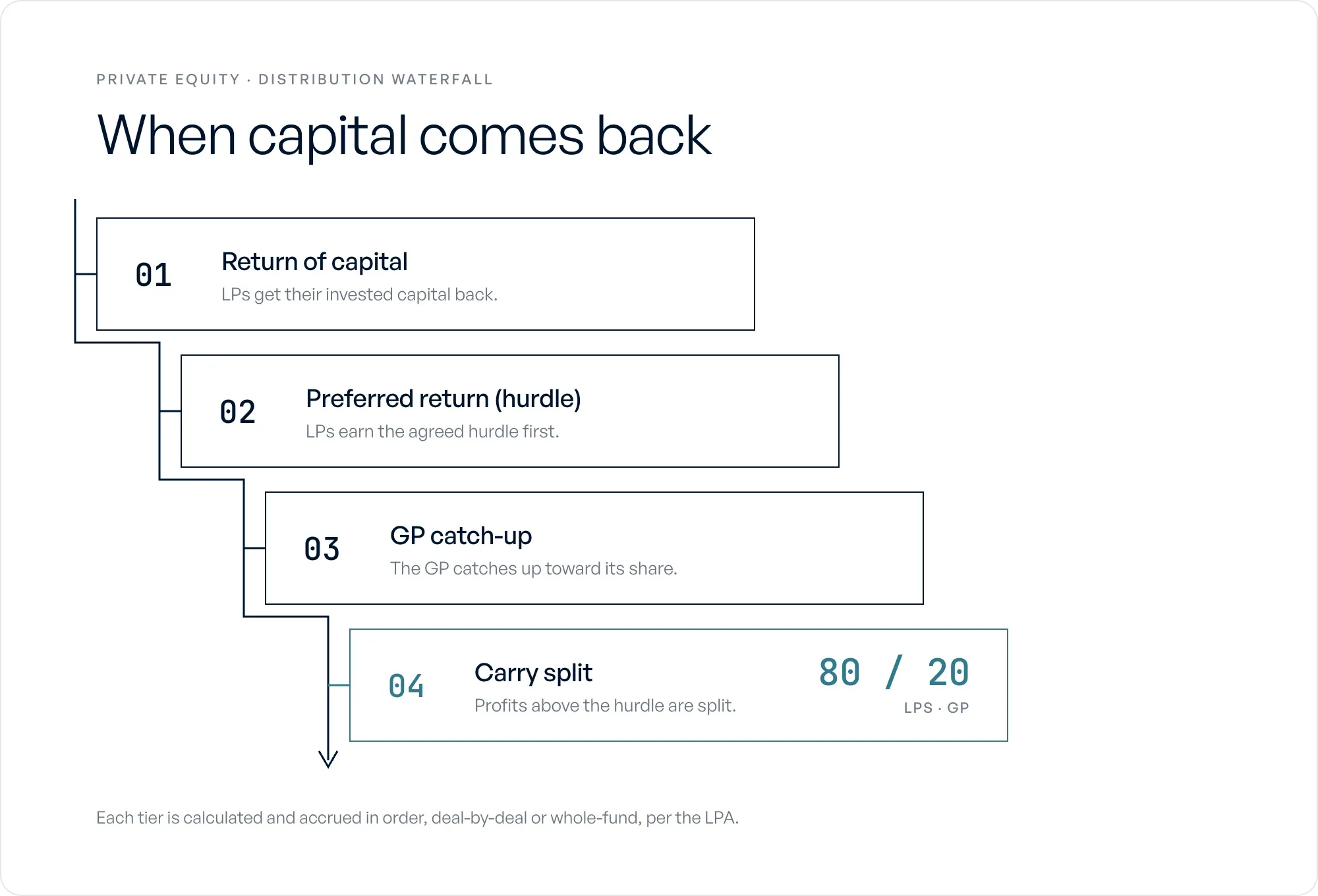
When capital comes back, it flows down the waterfall tiers per the LPA.
The core processes you have to get right
Underneath the life cycle are the recurring jobs that fill the fund accountant's quarter.
Capital-call and distribution accounting. Every drawdown and every distribution has to hit the fund and each LP's capital account in the right proportion, net of any recallable amounts. Get the pro rata math wrong and the capital accounts drift out of balance.
Management fees and offsets. Funds accrue a management fee to the manager, usually on committed capital during the investment period and on invested or net cost after it. Fee offsets, where monitoring or transaction fees reduce what LPs pay, sit here too and cause restatements when tracked by hand. ILPA's reporting template is the LP-side standard for disclosing these fees and offsets.
Portfolio valuation and NAV. Holdings are marked to fair value under ASC 820 each quarter, following the AICPA's investment-companies guide. NAV per the partnership rolls up those marks plus cash, less liabilities and accrued carry, and feeds every LP statement. Our guide to partnership accounting software for private equity compares the systems that keep those capital accounts.
The distribution waterfall and carried interest. When capital comes back, the waterfall dictates the order: return of capital, the preferred return (hurdle), a GP catch-up, then the carry split, typically 80/20 above the hurdle. Each tier has to be calculated and accrued correctly, deal by deal or on a whole-fund basis depending on the LPA.
Partner capital accounts. Each LP's capital account is the running record of contributions, allocated gains and losses, fees, and distributions. The capital-account statement is what the LP reconciles against, so it has to be exact.
The schedule of investments (SOI) and LP reporting. The SOI lists every holding with cost, fair value, and ownership; alongside the capital-account statement, the financials, and the cash-flow schedule, it makes up the quarterly reporting package LPs and auditors rely on.
Why is private equity fund accounting uniquely hard?
Here is where the standard explanation stops being useful, and where our own data starts. Across 80 fund finance teams Ceviche spoke with in 2026, 96% named multi-entity allocation as a core source of complexity. It is the most universal pain in the dataset, and it tracks structure, not assets. A firm running three funds, a couple of SPVs, a GP, and a management company already maintains six or more sets of books that each need a slice of every shared bill.
The structure is only half of it. The systems do not connect either: 92% of those teams were running allocations across tools that do not talk to each other. The recurring stack is an expense or AP system on one side, a general ledger on the other, and a spreadsheet in the middle doing the actual split. Nothing carries the line-level decision from one system to the next, so a person re-keys it every close. The structural detail is in our multi-entity allocation benchmark, and the systems data is in the fund finance tech stack.
And most of this still happens in Excel. 81% of those teams were allocating expenses in a spreadsheet in 2026. The spreadsheet is the source of truth, one person maintains it, and it usually carries no record of who decided what. It holds up until the entity count climbs or that person leaves. As one controller in the research put it, "we just keep a record of everything in Excel, and I'm sure the SEC will love that when they come knocking." Allocating, not posting capital calls and waterfalls, is what fund accounting actually looks like from the controller's seat. The full picture is in our state of fund expense allocation report.
Why is allocating shared costs the hardest part?
Ask which cost is hardest to allocate and one answer comes back more than any other. 63% of the teams in the 2026 research named legal-invoice allocation among their hardest problems, the sharpest single pain after the structural ones. An outside-counsel invoice is not one charge; it is dozens of timekeeper lines and disbursements spanning several matters, and a deal pursued across funds arrives on one document that has to be split across every vehicle that touched it.
Legal invoice allocation. A single outside-counsel invoice, often in LEDES format, frequently covers work that benefited multiple fund entities at once. Allocating it means splitting each line across the funds, the GP, co-invest SPVs, and the management company using the methodology the LPA supports for that cost, then posting the result to each entity's ledger with the rationale attached.
A worked example makes the shape concrete. Outside counsel sends one invoice for $180,000 covering a platform acquisition the firm pursued across two funds and a co-invest SPV. It carries 31 timekeeper lines. The split is not uniform:
| Invoice lines | Amount | Allocation methodology | Result |
|---|---|---|---|
| Deal diligence and negotiation | $150,000 | Committed capital across Fund I, Fund II, and the co-invest SPV | Fund I $82,500 (55%), Fund II $45,000 (30%), SPV $22,500 (15%) |
| SPV formation | $20,000 | Specific entity (the SPV used it) | SPV $20,000 |
| General fund-counsel advice | $10,000 | Management company (an operating cost) | ManCo $10,000 |
Three methodologies on one invoice, four sets of books, and a due-to/due-from entry between them so each fund ends up square. A controller in the research described getting "one invoice that sometimes gets allocated over like 10 different funds," by hand, every time. The intercompany mechanics underneath this are covered in due to / due from in fund accounting, and the benchmark numbers are in the legal-invoice allocation benchmark.
There is a prior question other guides barely answer at all: which costs can be charged to the fund versus the management company in the first place? Deal legal fees and fund audit costs are usually fund expenses; salaries, rent, and the firm's own overhead usually are not. The LPA is the rulebook, and miscategorizing the two is exactly the error examiners look for. We treated that question on its own in fund expenses vs management company expenses.
We compared the fund expense allocation software built for exactly this problem.
How do you prove your allocations in an audit or SEC exam?
The second hard part surfaces later, at audit or SEC exam. 49% of the teams in the research had a gap in their allocation audit trail: the split gets made, but the record of why each line went where it did does not survive in a form an examiner would accept. It is the quiet risk, because it costs nothing until someone asks, and then it costs a great deal.
Fee and expense allocation is a standing focus of the SEC's Division of Examinations for private fund advisers, and the question examiners press is whether the methodology is documented and applied consistently with the fund documents. A team without a trail described its support for a past allocation as "somebody writes a paragraph after the meeting." A team with one handled an exam request in minutes. The numbers are in the audit-trail gap benchmark.
The size of the prize is worth naming. One multi-billion-dollar fund cut its month-end allocation work from roughly ten days of manual reconciliation to a one-to-two-hour automated run, taking five to ten days off close. That came from making the allocation logic consistent and writing the entries and audit trail back automatically, not from working faster by hand. The close-time data sits in the fund close-time benchmark.
If the trail already has holes, start with fixing allocation errors before the audit.
In-house or outsourced fund administration?
Most firms answer this once and revisit it when the entity count grows. A fund administrator runs NAV, the books, and LP reporting for a fee, which buys capacity and an outside check on the numbers. The trade is distance: the people closest to the allocation judgment sit outside the firm, and the firm still owns the answer when an LP or an examiner asks. Many teams in the research keep a fund admin for NAV and reporting while keeping allocation in-house, because the judgment is hard to delegate and harder to defend secondhand. The deeper trade-offs are in fund administration in private equity.
Software and systems that support PE fund accounting
There is little public data on what private funds actually run, so here is ours. Among the teams in the 2026 research, QuickBooks and NetSuite together serve about 73% of management-company general ledgers, usually with a separate fund-side system (Investran, Allvue, Carta, Geneva) behind them. On the spend side, Ramp, Bill.com, and Expensify dominate. The full distribution is in the fund finance tech stack, and a buyer's view is in fund accounting software and our private equity fund accounting software comparison.
That split is the real engineering problem. The work is rarely about moving a fund onto a new ledger; it is about bridging the management-company GL the firm already runs and the fund-side system behind it, so a shared cost can be allocated once and post correctly to both. Software that ignores the existing stack tends to become the fourth system nobody opens.
Where does Ceviche fit?
Ceviche is audit-grade fund expense allocation software that sits between the spend systems funds already use (Ramp, Bill.com, Brex, Expensify, SAP Concur) and the general ledger (QuickBooks Online, NetSuite, Sage Intacct), applies the firm's allocation methodologies per the LPA, and writes audit-ready journal entries back with the rationale attached. Flybridge runs it across 18+ fund entities on QuickBooks Online and Bill.com. Ceviche has completed its SOC 2 Type 2 audit. You can see how Ceviche handles fund expense allocation.
Frequently asked questions
What is fund accounting in private equity? It is the method of tracking how LP capital is committed, called, invested, valued, and returned across a closed-end fund's life, with separate books for the fund, the GP, and the management company. It measures accountability to LPs rather than profit, and in daily practice it centers on allocating shared costs correctly across all those entities.
How much does a private equity fund accountant make? Compensation varies by firm size, location, and seniority, so treat any single figure with caution. The role spans junior fund accountants through controllers and CFOs, and pay tracks the complexity of the structures involved more than headline AUM. Check live salary data for current ranges rather than a static number in any guide.
What is PE in fund accounting? PE stands for private equity. In fund accounting, it refers to closed-end funds that buy ownership stakes in private companies, draw committed capital through capital calls, hold investments at fair value, and return capital and gains to LPs through a distribution waterfall, all tracked across the fund, the GP, and the management company.
What is the 80/20 rule in private equity? It refers to the standard carried-interest split: once a fund returns LP capital and clears the preferred return (the hurdle), profits above that point are typically divided 80% to the limited partners and 20% to the general partner as carry. The exact terms and the catch-up mechanics are set in each fund's LPA.
What are private equity fund accounting journal entries? They are the postings that record fund activity: capital calls debiting cash and crediting capital accounts, investments, fair-value adjustments, management-fee accruals, distributions, and the intercompany due-to/due-from entries that keep funds square when a shared cost is split among them. A single allocated legal invoice can generate entries across several entities at once.
Is private equity fund accounting done in-house or outsourced? Both are common. Many firms outsource NAV, the books, and LP reporting to a fund administrator while keeping expense allocation in-house, because allocation judgment is hard to delegate and the firm still owns the answer in an SEC exam. The right split usually tracks entity count: more vehicles push more of the hard judgment back inside the firm.
What expenses can be charged to the fund versus the management company? The LPA decides. Costs tied to the fund's investments, such as deal legal fees, fund audit costs, and certain organizational expenses, are usually fund expenses. The firm's own operating costs, like salaries and office rent, are usually management company expenses. Miscategorizing the two is a primary focus of SEC examiners, so the methodology has to be documented and applied consistently.