
TL;DR
For fund managers, the best multi-entity accounting software depends on which problem is breaking. NetSuite and Sage Intacct consolidate entities upward into one set of financials, while Allvue, FundCount, and LemonEdge run fund-native ledgers with capital accounts. Ceviche solves the downward problem: allocating one shared cost across funds, co-invests, and the management company.
Why Does Multi-Entity Accounting Break at Fund Structures?
Multi-entity accounting software was built for a company with subsidiaries. A parent owns five operating companies, each keeps its own books, and the software rolls them up into one consolidated statement with the intercompany activity eliminated. For the businesses it was designed for, it works.
A fund manager's entity stack does not behave like subsidiaries. A mid-sized PE firm runs a management company, a GP entity per fund, the funds themselves, and usually a co-invest vehicle or an SPV per deal. The entities do not roll up. Fund II's LPs and Fund III's LPs are different investors with different rights, so there is no meaningful consolidated statement across them. What the entities share is cost. The audit fee, the D&O policy, the fund administrator's bill, and every outside-counsel invoice arrive addressed to one entity and legally belong, in fractions, to several.
The direction of travel separates the two jobs. Consolidation moves numbers up the structure into one view. Allocation moves one number down the structure into many ledgers, each split governed by an LPA clause. Of the 80 fund finance teams we spoke with in 2026, 96% cite multi-entity allocation as a core complexity, and 92% run allocations across disconnected systems. The scale of the problem tracks structure rather than size: a $600M firm with twelve vehicles feels it harder than a $3B firm with four.
Teams that live inside that structure describe the same arc. The CFO of a mid-market PE firm running more than 20 vehicles put it to us this way:
"That was sustainable when we had three funds. It is not necessarily sustainable now."
A CFO at another multi-fund firm told us their tax advisers send an invoice per vehicle every cycle, dozens at a time, and the legal bills arrive the same way. The entity count grows deal by deal, and the accounting work grows with it whether or not the software was chosen for that shape.
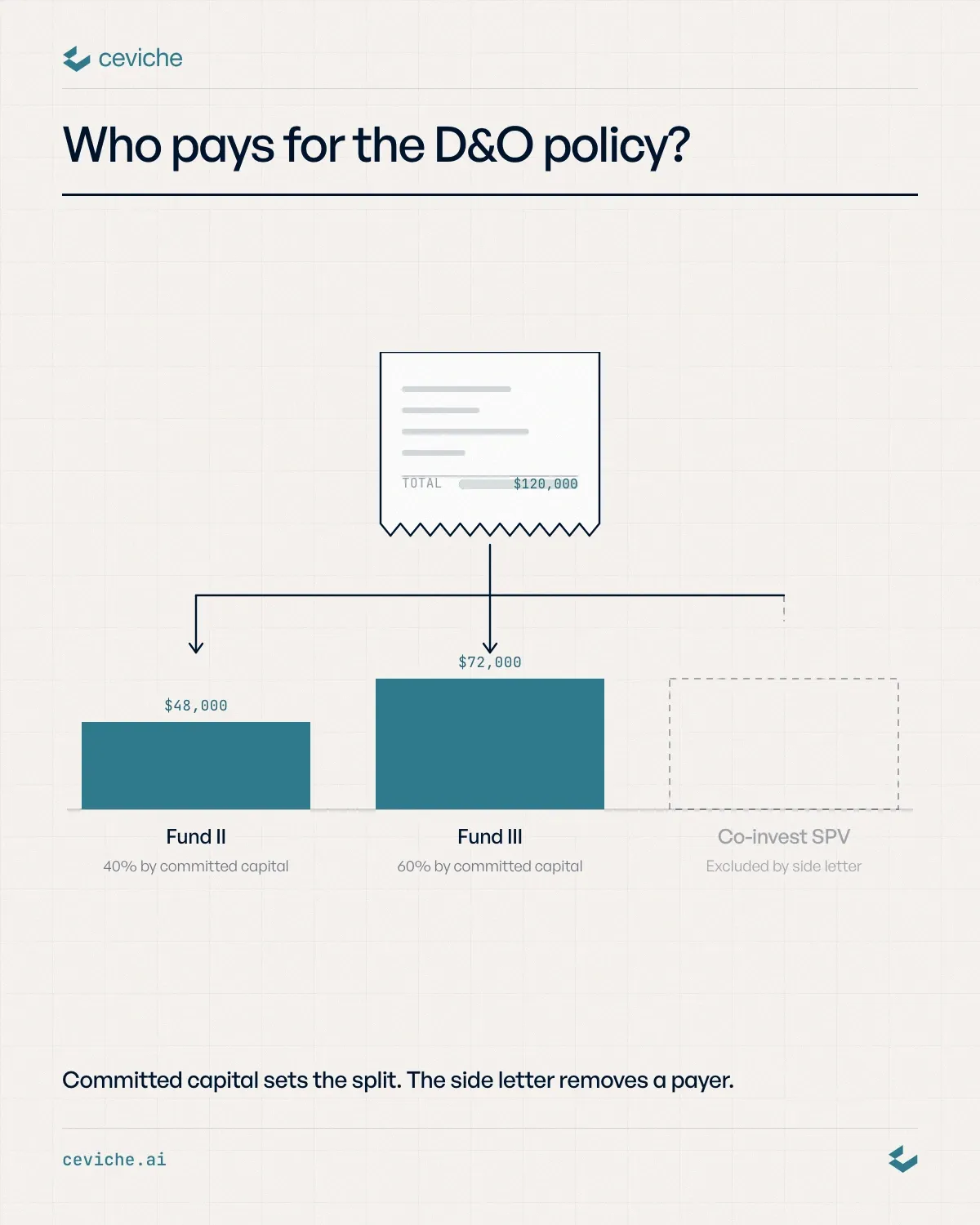
One invoice at the management company, allocated down the entity stack by committed capital; the excluded vehicle is documented, not ignored.
What Does Multi-Entity Accounting Software Do?
Multi-entity accounting software keeps a separate general ledger and chart of accounts for each legal entity in a group, automates intercompany transactions and eliminations, supports multiple currencies, and consolidates every entity into one set of financials with drill-down to any single entity. Fund managers need one more motion it does not include: rule-based cost allocation across entities.
Our explainer on what multi-entity accounting software does covers the full capability set and its limits for funds. The short version is that per-entity ledgers, intercompany eliminations, and consolidated reporting are table stakes across the category. The differences that matter to a fund manager are which platforms understand capital accounts, and which understand that a 25-line legal invoice needs a different split methodology per line.
The Platforms Compared
Nine platforms cover the serious answers, across three tiers. ERP consolidation platforms (NetSuite, Sage Intacct, Dynamics 365 Business Central) handle multi-entity structure generically. Fund-native ledgers (Allvue, FundCount, LemonEdge) add capital accounts and partnership accounting. The allocation layer splits shared costs across whichever of those ledgers you run: Ceviche is the entry with its own section below, IntegriDATA EAS brings the deepest enterprise pedigree with a full action-level audit trail and named write-back to SAP, Oracle, and QuickBooks, and StavPay is the managed-service route whose strength is taking the allocation work off your team entirely, vendor-run on your stack. Both appear in the table below and in our dedicated comparison pages.
Excel deserves an honest fit note too. A firm with two or three vehicles, stable methodologies, and low invoice volume can run allocation in a spreadsheet indefinitely; the 81% of teams still there are not all wrong. The spreadsheet breaks on entity count and audit scrutiny, not on principle.
Ceviche
Ceviche is the allocation layer for PE and VC finance teams whose entity stack has outgrown manual splitting. Disclosure: Ceviche publishes this article.
Ceviche is not a multi-entity general ledger, and it does not want to be. It sits between your expense systems (Ramp, Bill.com, Brex, Expensify, SAP Concur) and whatever GL each entity already runs, applies the allocation rules written in your LPAs, and posts audit-ready journal entries into each entity's books. The invoice that names one entity and belongs to five is the exact case it was built for: each line carries its methodology, its LPA basis, and its approval, so an auditor sampling any allocation gets the full trail in one place.
Flybridge runs 18+ fund entities on a QuickBooks Online and Bill.com stack. Before Ceviche, its quarterly allocations ran in spreadsheets. Onboarding typically runs 2 to 4 weeks. Allocations now run through Ceviche and post to QuickBooks Online, every allocation traces back to source documentation with a full audit trail, and the controller reviews exceptions instead of rebuilding formulas.
The boundary: if your entities need new ledgers, Ceviche does not provide them. It assumes a GL exists per entity and fixes the layer where 81% of the 80 teams we studied still allocate in Excel.
NetSuite
NetSuite is the default multi-entity ERP for firms consolidating operating businesses, and its OneWorld module handles per-entity books, currencies, and intercompany eliminations at genuine scale. Management companies run it well, and in our 2026 calls the most common migration path we heard was QuickBooks Online to NetSuite. What it does not carry natively is fund logic: no capital accounts, no LP-facing allocations, and no per-line invoice splitting by LPA methodology. Firms that run NetSuite at the management company usually pair it with a fund admin or a fund ledger for the funds themselves, then handle shared-cost allocation in spreadsheets between the two. For consolidation at the management company it is a strong answer; the allocation work stays wherever you run it today.
Sage Intacct
Sage Intacct is the other mid-market consolidation standard, with a dimensions model: entities, funds, and departments as tags on one chart of accounts rather than separate databases. Multi-entity consolidation, intercompany, and role-based access are mature. The fund gap is the same as NetSuite's. Dimensions let you report by entity, but nothing in the platform reads an invoice and decides that lines 1 through 9 split pro rata by committed capital while line 10 belongs to one co-invest. Intacct firms in our study did that work outside the system, then keyed the results back in.
Microsoft Dynamics 365 Business Central
Dynamics 365 Business Central, often deployed for investment and holding structures through partners like Gravity, brings the Microsoft stack's reporting and a native multi-company model. The multi-entity mechanics carry known friction: in the older Dynamics GP line, a transaction touching five entities meant five separate logins, and the same source describes Business Central routing intercompany entries through an inbox a second user accepts before they post. For a fund manager the evaluation lands where NetSuite's did: strong consolidation for the management company, with the fund-specific gap unchanged.
Allvue Systems
Allvue is the front-to-back private capital platform: fund accounting, portfolio monitoring, investor portal, and reporting in one Microsoft-based system, deployed widely by fund administrators. Multi-entity fund structures are native, and partnership accounting is a module of its own rather than a bolt-on. The trade-off is weight. Allvue is enterprise infrastructure a firm adopts as its accounting operation, and public sources disclose neither an implementation timeline nor pricing. A three-person team does not install Allvue to fix invoice splitting; a firm replaces its stack with Allvue and gets multi-entity fund accounting as part of the platform.
FundCount
FundCount unifies partnership accounting and portfolio accounting on one general ledger, and its pitch names the problem plainly: firms either run partnership accounting in a spreadsheet bolted onto a generic GL, or pay twice for an investment platform and an accounting system that disagree about what a partner owns. It is strongest where entity counts and ownership webs are densest, family offices especially, with multi-entity views across a family's structures. It is a ledger replacement: capital accounts, allocations to partners, and consolidated views live inside FundCount, so adopting it means moving the books. Expense allocation across entities exists as ledger capability, driven by the ownership structure you configure, rather than as an invoice-level workflow with per-line LPA methodology. We compare it in depth in FundCount alternatives.
LemonEdge
LemonEdge is the modern fund-accounting challenger: real-time processing across a full fund structure with look-through, complex vehicles and hierarchies in one system, and low-code customization aimed at firms that have outgrown legacy platforms but do not want an enterprise deployment. It handles multi-entity fund structures natively and is credible for GP-led secondaries and continuation-vehicle complexity. Like FundCount, it is the ledger: you adopt it as the system of record for the funds. Shared operating costs still cross the management-company boundary every close, and that split is configured and run by your team, in or alongside the platform.
Platform Comparison Table
| Platform | Category | Fund Structures Native | Shared-Cost Allocation | Adoption Weight |
|---|---|---|---|---|
| Ceviche | Allocation layer | Works across existing stack | Per-line, LPA-based, automated | ~2 to 4 weeks, keeps your GL |
| NetSuite | ERP consolidation | No | Manual outside the system | Migration project |
| Sage Intacct | ERP consolidation | Partial (dimensions) | Manual outside the system | Migration project |
| Dynamics BC | ERP consolidation | No | Manual outside the system | Partner-led deployment |
| Allvue | Fund platform | Yes | Inside the platform, module-level | Replaces the stack; timeline not published |
| FundCount | Fund ledger | Yes | Ledger-level, structure-driven | Books migration |
| IntegriDATA EAS | Allocation layer | Works across enterprise GLs | Per-line, action-level audit trail | Enterprise deployment; timeline not published |
| StavPay | Managed allocation service | Vendor runs your structure | Done for you, vendor-maintained | Service engagement |
| LemonEdge | Fund ledger | Yes | Ledger-level, workflow remains | Books migration |