The term covers two different purchases, software you operate and a firm you hire. Here are the four delivery models, who fits each, and what every provider leaves on your desk.
TL;DR
Providers split into four delivery models. They are software an administrator licenses, software a general partner licenses, platform administrators selling technology plus their own accountants, and full-service firms selling people first. The question that separates them is who owns the general ledger your funds run on, so ask it before comparing anything else.
Fund Administration Software Providers Are Two Different Purchases
The term covers two purchases with almost nothing in common. Some providers sell a system that fund administrators themselves operate. Some sell administration as a service, delivered by people, running on a ledger you will never log into. Buying the wrong one means buying something that never touches the problem.
Fund administration is the outsourced service a GP buys to run a fund's middle and back office. It covers fund accounting plus investor servicing and onboarding, capital calls and distributions, the investor register and reporting package, AML and KYC checks, and support for audit, tax, and regulatory filings.
The distinction is not academic. A controller at a venture and credit firm told us nobody on his fund team has direct access to the ledger their own funds actually run on. The administrator holds it, and the firm queries reports through a tool built on top of it. That is a workable arrangement and a very different purchase from licensing a platform. For the split between the service and the accounting function underneath it, our explainer on fund administration is the primer.
A ranked comparison of the products sits in our guide to fund administration software. What this page sorts is the delivery models they arrive in.
The Four Delivery Models and Which One You Are Actually Buying
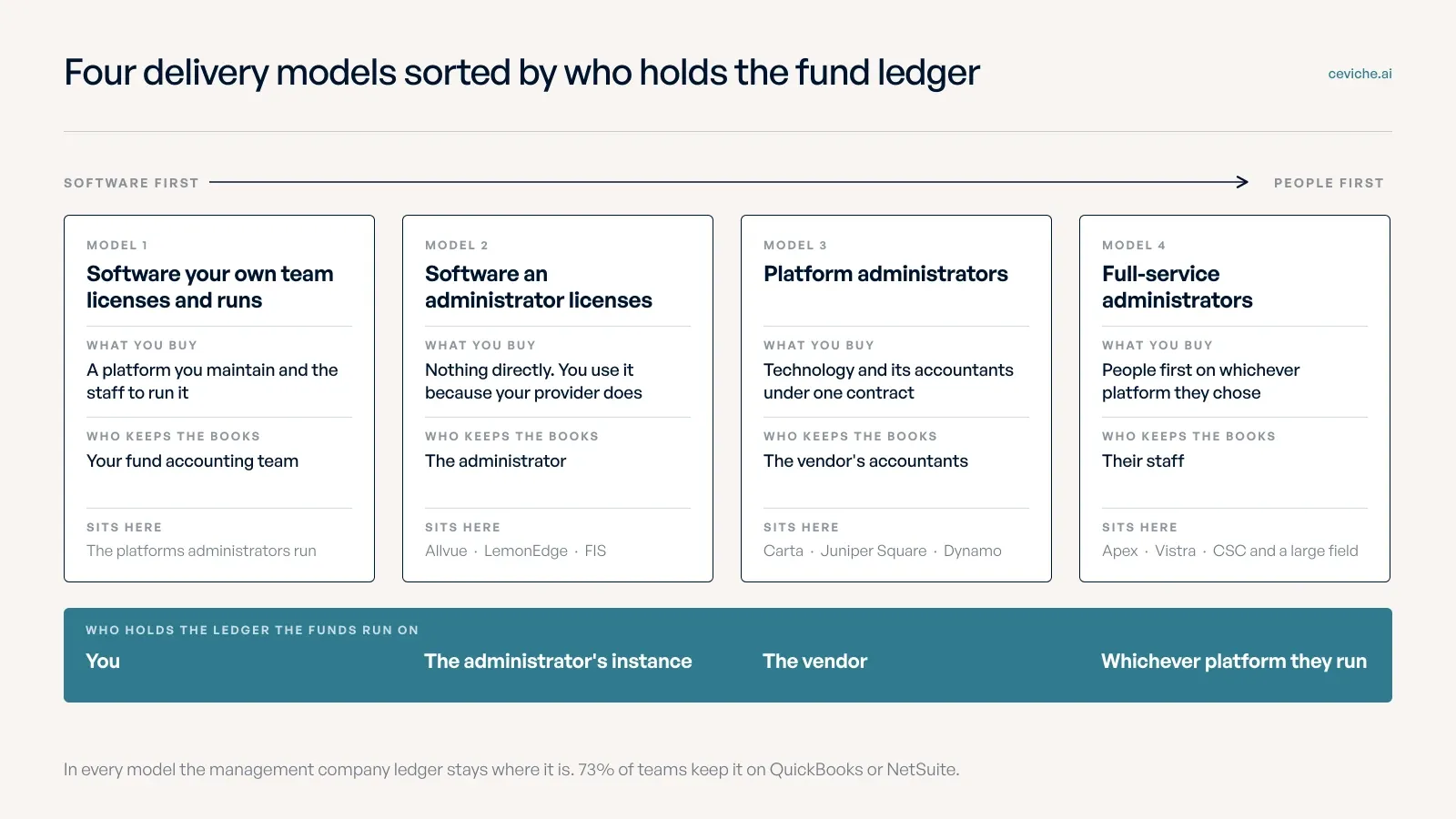
Software an Administrator Licenses
Allvue, LemonEdge and FIS sell to the administration firm, not to you. If your administrator runs one of these, you are already a user of it without having bought it, and its roadmap is your roadmap.
Software a General Partner Licenses and Operates
Rarer than the category implies, and it means your own team runs fund accounting in-house on a platform you maintain. The platforms are largely the same ones administrators run, so the buyer here is deciding to carry the implementation and the fund accounting staff rather than choosing a different product. Allvue publishes a corporate accounting module aimed at private capital GPs.
Platform Administrators
Carta, Juniper Square and Dynamo sell technology and their own accountants together. One contract, one data model, and your fund books live inside that vendor.
Full-Service Administrators
Apex, Vistra, CSC and the rest of a large field sell people first, running whichever platform they chose. The Drawdown's fund administration directory is the only neutral roster of this group we know of, with published assets under administration, manager counts and service scope per firm.
There is a fifth shape the category rarely names, and two firms we spoke with are in it. At one large buyout manager, three administrators log into the firm's own fund ledger and book entries there while fund accounting stays in the building. At a venture manager with no external administrator at all, fund accounting stays inside a team whose members have fifteen-plus years of tenure. The cost crossover, the control question and the LP reaction are worked through step by step in our piece on when to bring fund administration in-house.
See it on one of your own invoices. Ceviche pulls the invoice from Ramp, Bill.com, Brex, Expensify or SAP Concur, applies the allocation methodology each LPA specifies per line, and writes audit-ready journal entries back into QuickBooks Online, NetSuite or Sage Intacct. Book a demo.
| Provider | Who Licenses It | Who Keeps the Books | Who Owns the Fund GL | ManCo Books in Scope | Investor Portal | Cross-Entity Expense Allocation as Published |
|---|
| Allvue | The administrator | The administrator | The administrator's instance | Yes, a named corporate accounting product | Yes | Not mentioned on the page |
| LemonEdge | The administrator | The administrator | The administrator's instance | Not mentioned on the page | Yes, white label | Once, as GP allocations inside Algorithms |
| Carta | You, as a service | Carta's accountants | Carta | Not mentioned on the page | Yes | Not mentioned on the page |
| Juniper Square | You, as a service | Juniper Square's team | Juniper Square | Yes, management company accounting | Yes | Handled by its team, per its page |
| Full-service firms | You, as a service | Their staff | Whichever platform they run | Varies; several publish ManCo services | Varies | Not mentioned on the pages |
| Ceviche | You | You | Unchanged, yours | Yes, that is where it starts | No | Per line, by LPA methodology |
Vendor details change. Every cell above comes from the vendor's own page as it read on 2026-09-03, and none of these vendors publishes prices.
The Providers Grouped by Delivery Model
That missing price is why every grid in this category, including this one, stops short of the number that decides the shortlist. Ceviche publishes this page and sells software in the expense allocation category, so read our own entry with that in mind. What each provider does comes from what it says about itself, with the source linked the first time it appears. Nothing here is ranked by quality, because our data cannot support that ordering.
Allvue
Allvue's fund administration page is written for administrators rather than for general partners, and it names the modules plainly. Fund Accounting is "A complete back-office solution that combines detailed financial statement reporting, a true general ledger, cash management and workflow standards", and the rest of the set runs to a Client Hub opened up to auditors, an Investor Portal, Business Intelligence through Microsoft Power BI, and a Corporate Accounting module the page calls "management company accounting software that's designed especially for private capital GPs". A Fund Administration Essentials bundle targets administrators still building a client book.
Allvue fits an administration firm scaling its business, or a very large manager running fund accounting in-house with the implementation resources an enterprise platform needs. If you are a three-person finance team, the buyer here is not you.
LemonEdge
LemonEdge sells to service providers running many clients at once. Its fund administration page describes a "cloud-native, API-based platform delivered as SaaS" with "an optional self-hosted installation in your own secure cloud", and a data-isolation model so a multi-office provider can guarantee its clients' records stay separate. Algorithms is its named answer to offline Excel, with use cases including "bespoke performance calculations, waterfall calculations, or further the GP allocations for your clients".
Multi-jurisdictional AML and KYC configuration is the strongest reason a cross-border book ends up here. The buyer is the service provider, not you, so the useful move is to ask which platform yours runs, and the shortlist a provider weighs it against is in our guide to LemonEdge alternatives.
FIS Private Capital Suite
FIS pitches Private Capital Suite on removing the manual layer, offering to "Automate fund and partnership accounting to improve accuracy and reduce operational costs", with investor management and digital data exchange alongside it. It sits at the enterprise end and shows up most often behind an administrator or a very large manager.
Carta
Carta sells administration as a service on its own software, promising "fund admin at the intersection of world class service and autonomous agents" and operations running "in a matter of weeks" with committed onboarding timelines. Its published scope covers fund formations, SPVs, capital calls and distributions, KYC and AML screening, portfolio valuations, a deal and LP CRM, Fund Tax as an add-on, and real-time net and deal IRR, TVPI and DPI.
The fit is a venture or emerging private equity manager happy to keep cap table, administration and tax with one vendor, and untroubled by fund books that live inside that vendor. The friction shows up later, when a firm running its own management-company ledger wants the fund-side record somewhere it can move, which is the trade the Carta fund administration alternatives comparison works through.
Juniper Square
Juniper Square's administration page states that GPs trust its "connected fund administration services to support everything from SMAs to large, global, cross-jurisdictional funds for over $200B of assets", claims "94% annualized retention of our fund accounting and investor services staff", and describes "the #1 portal, trusted by over 650,000 LPs with over $1T of equity". Its service list runs Fund Accounting, Treasury Services, Investor Services, Investor Onboarding, AML and KYC, and Management Company Accounting.
It is the one provider on this page whose own words address the split directly, offering to "Outsource your fund financials and complex allocations to our expert team". The allocation gets done by people, which is a real answer and a different one from a system applying your methodology. Real-estate-heavy sponsors are its strongest base, and anyone weighing that model against a lighter one should read our Juniper Square alternatives guide.
Dynamo
Dynamo runs fund administration services off the platform its front-office products already sit on, and its accounting page describes "a fully integrated general ledger purpose-built for GPs" that "seamlessly manages capital calls, distributions, fee calculations, waterfall models, and investor allocations" and automates capital account maintenance. Allocation there means investor allocations rather than shared costs across entities, and Dynamo fits firms already standardized on it for deal flow or investor relations.
BlackRock eFront
eFront covers fund administration and accounting across alternative asset classes and its page addresses general partners and asset servicers on the same solution line. A firm can therefore end up reading eFront output because its administrator chose the platform rather than because it licensed anything. It fits large multi-asset books with a systems team behind them.
The Full-Service Administrators
This group is large, and it is where most PE and VC funds above roughly $500M actually land. Apex says fund administration "is where our business started and is the cornerstone of our single-source solution offering", built on "timely, accurate, and independent fund administration services for alternative investment and traditional funds". Vistra publishes fund formation, domiciliation, KYC and AML, directorship and AIFM ManCo services alongside fund accounting, on a book it states at $1 trillion in assets under administration across more than 12,000 structures in over 50 jurisdictions. CSC's private equity scope includes one line no other page on this list carries, "Preparation and maintenance of the annual expense budget", which is expense planning in scope and stops short of the split itself.
For the rest of the field, use The Drawdown's directory rather than any vendor's list. Our primer on fund administration in private equity covers what to put in the RFP.
Ceviche
Ceviche is not fund administration. It sits in the grid above to mark the boundary rather than to compete for the same purchase. It covers the one job every option here hands back, which is splitting a shared cost across the fund entities by the rules your team approved and proving the basis afterward. The methodology comes from the fund agreements, the entries land in whichever general ledger the management company already runs, and the administrator keeps executing on its own platform. Flybridge runs it across 18+ fund entities with no change to the Bill.com and QuickBooks Online stack underneath, and its quarterly allocations no longer live in spreadsheets.
How Do You Evaluate a Provider Beyond the Feature Grid?
The feature grids in this category are close to interchangeable, and the things that actually decide the relationship are not on them.
Score Service and Technology Separately
A controller at a venture and credit firm put it in one line. His provider's people were excellent, with deep knowledge of the firm and long tenure on the account, and the technology was not up to standard. He was warning a software vendor off integrating with his own administrator's interface. Provider evaluations collapse those into one score. Buyers live them as two.
Ask How the Account Is Staffed Because That Is the Product
Two firms can sell the same service and staff it in opposite ways. One assigns an accountant per fund, so each person sees one fund's books. The other pools a team of around ten across every fund and organizes them by process, so a single person owns all the due-to-manager and due-from-fund bookings for the whole complex. That decides who you call, what any one person can see, and how many people need access if you ever put software on top. A finance lead at a venture firm made the same point from the other end after her whole account team left for a competitor. Same people, new firm.
Ask What the Provider Will Not Build
A finance lead who had already switched administrators told us the management-company dashboard she was promised is not a product priority. Roadmaps are the quiet variable here, and no comparison page carries them.
Ask Whether the Provider Recommends Software at All
A fund controller at a buyout firm told us nobody in his market will name a tool, because a recommendation that goes wrong lands on the recommender. He had worked in markets where the opposite was true and administrators volunteered suggestions. Establish early which kind yours is.
Ask What Happens to Your Data if You Leave
Buyers raise this last and should raise it first. Ask what format the fund ledger comes out in, whether you receive posted entries or only the reporting package built on top of them, how far back the extract runs, and who pays for the migration work if the answer is that the data needs rebuilding.
What Does Every Provider Leave on Your Desk?
Two things, in almost every firm we have spoken to.
The first is the management company. In firm after firm the provider covers the funds and the management company sits somewhere else, usually in QuickBooks or NetSuite and usually maintained in house. Three finance leaders told us this without being asked. One added the part that matters, that his firm once had a single provider on both sides, split them before his time, and that the sensible arrangements are one provider for both or none at the management company. Nobody argues for the arrangement most firms are actually in. Of the 80 fund finance teams we spoke with in 2026, 73% run their management-company general ledger on QuickBooks or NetSuite, QuickBooks at 51% and NetSuite at 23%. Whichever provider you pick joins that stack rather than replacing it.
The second is the split itself. Only one page on this list treats it as its own answer, and that answer is people. Where the word appears elsewhere it means something else, GP allocations inside one LemonEdge feature and investor allocations on Dynamo's accounting page, and Allvue's administrator page does not carry it at all. That is the seam, and 96% of the teams we interviewed call multi-entity allocation a core source of complexity while 92% run it across disconnected systems that never carry the split forward.
Here is what fills that space today. Past a few dozen entities the eligibility rules end up written down somewhere outside every provider's system. A finance operations lead at a private credit manager keeps hers in a single spreadsheet, one row per legal entity with its assets each quarter, and beside it a grid mapping each expense type to the subset of funds allowed to bear it, split either on assets or evenly inside that subset.
Take one quarter of that file. A market-data subscription costs $84,000 for the quarter and the grid says six credit funds are eligible, with assets of $1.2B, $900M, $750M, $600M, $350M and $200M against a $4.0B base. Pro rata by assets, that is $25,200, $18,900, $15,750, $12,600, $7,350 and $4,200. A regulatory filing fee of $27,000 has a different eligible set, the nine funds registered in that jurisdiction, and the grid says split it evenly, so each carries $3,000. Same file, same quarter, two expense types, two eligible sets and two methodologies. No provider platform on this page holds that grid, which is why it lives in a spreadsheet on one person's machine and why 81% of those teams are still doing it there.
Ask where the allocation work sits on the bill and, in the evaluations we run, it is not on the bill at all. It is inside the annual service fee, and people are doing it by reviewing transactions by hand. A firm saying its administrator handles allocation has bought exactly that.
Why Do Firms Not Switch and What Do They Do Instead?
Switching is the move these comparisons are built around, and the buyers we interviewed mostly do not make it. One firm ran the full market survey across every administrator, on the chief financial officer's instruction, and keeps re-running it. The answer comes back the same each time.
There are a lot of admins that do have shiny tech that is really attractive. But then you have to marry that with all of these customizations that we've been accommodated for.
Two things sit on the other side of that scale. Years of accommodated customizations, and the legacy knowledge of an account team whose average tenure on that one client runs five to seven years. If the out-of-the-box platform cannot carry the customizations, the firm loses both at once, and the technology it gained was never the binding constraint.
So the live alternative is not a switch. It is keeping the administrator and putting a new piece of software in front of it, which that controller notes is a harder conversation than it sounds, and which is the decision most readers of this page are actually making. Whatever the platform looks like in a demonstration, the interface most firms get is a spreadsheet or a second set of books. One controller described his arrangement as the administrator having the platform while his own firm keeps QuickBooks in the shadow.
Ceviche fits when
Ceviche fits when you have already answered the provider question and do not intend to reopen it. The entity count is past a handful, the shared-cost split still comes out of a spreadsheet each close, and two to five people at a firm somewhere between $500M and $15B are doing it. What Ceviche is not covers most of this page. It is not a fund administrator, a general ledger or a managed service, and it does not do the allocations for you. A firm that needs any of that hires a provider above and puts Ceviche on top of the result.
Frequently asked questions
Should I switch providers or add a layer on top of the one I have?
Start by naming which part is failing. If the service is good and only the technology disappoints, switching costs you the account team and every customization you have accumulated, and buys you a platform you still have to configure. Adding a layer keeps both and changes one workflow. If the service itself is failing, no software in front of it will fix that.
What are some reputable fund administration service providers?
The Drawdown's fund administration directory is the only neutral roster we know of, and Apex, Vistra, CSC, Alter Domus, Citco, Gen II, IQ-EQ and SEI all appear in it with their scope and their books published. A much longer field sits behind them. The directory lists assets under administration, manager counts, client strategies and services per firm, which beats any vendor-written list including this one.
Who is the largest fund administrator?
By the assets under administration each firm publishes in The Drawdown's directory, Apex Group sits at $3.1 trillion, ahead of BNP Paribas at $2.72 trillion and Alter Domus and Citco at $2 trillion each. Size is a proxy for stability and jurisdictional reach, not for fit. Several firms below $500 billion in that same table specialize in exactly the fund type a smaller manager runs.
What is the best fund accounting software?
Answer the delivery-model question first, because the two categories rarely compete. If you want a system your team operates, you are shopping fund-native ledgers. If you want a firm that keeps the books, you are shopping administrators and inheriting whichever platform they run. Our ranked guide sorts the products; asking your administrator what it runs answers it faster.
How do I weigh a provider's service against its technology?
Score them separately and write both down. The pattern we hear most often is excellent people on a dated system, and a single blended rating hides it. Ask which platform the account runs on, who else uses it, what the client-side interface actually looks like on a normal Tuesday, and whether the firm's own team can pull a number without asking somebody to write a query.
What happens when a firm uses more than one fund administrator?
Nothing joins them. Each provider reports on the funds it services, and the work of squaring those reports against each other sits with the firm rather than with any of them. Multi-provider is normal past a certain size and no contract makes one party responsible for the whole. Budget for the internal role that owns that seam before you sign the second provider.
