
TL;DR. Functional expense allocation splits a shared cost by its purpose rather than by what was bought, then reports each purpose separately. Nonprofits do this across three functions (program, management and general, fundraising) for their Form 990. A private fund does the same across legal entities under its LPA, which is harder because there are far more than three buckets.
What is functional expense allocation?
Functional expense allocation is the practice of grouping costs by the purpose they serve, not by the type of thing you paid for. The type of thing is the natural classification: salaries, rent, software, travel. The purpose is the functional classification: which activity the cost supported. A single salary line is one natural expense, but the person it pays might spend half their time on one purpose and half on another, so that one cost gets divided across two functions.
Picture it as a grid. Natural categories run down the side (salaries, occupancy, professional fees), functions run across the top, and every cost lands in a natural row then spreads across the functional columns. Nonprofits formalize that cross-classification in a Statement of Functional Expenses, but the underlying move, cost by purpose rather than by nature, is general.
What are the three functional categories?
For a nonprofit, the functions are fixed at three:
- Program services. The mission work itself: the costs of delivering whatever the organization exists to deliver.
- Management and general. Sometimes called G&A. Governance, accounting, the executive office, the costs of running the organization that are not tied to a specific program or to raising money.
- Fundraising. The costs of bringing in donations and grants: events, appeals, the development team's time.
Most costs are not purely one of these. An executive director's salary might be 60% management and general and 40% program if that is genuinely how the time splits. The grid forces every cost into the three columns, and the row has to sum to the natural total.
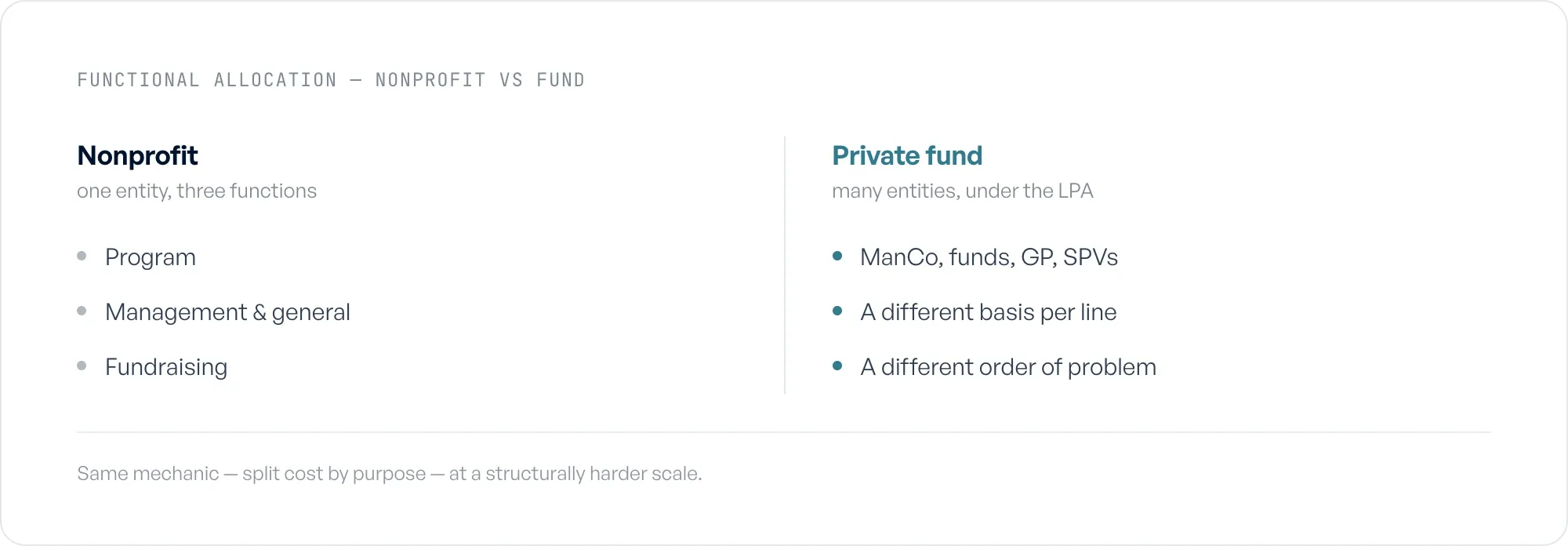
Same mechanic, split cost by purpose, at a structurally harder scale.
How do direct and shared costs get allocated?
A direct cost is identifiable with a single function, so it gets charged straight there. The fundraising gala caterer is a fundraising cost, full stop, no allocation needed.
A shared cost (also called indirect or joint) benefits more than one function, so it has to be split on a reasonable basis. This is where the work lives. The two workhorse bases are time-and-effort for payroll (timesheets or a documented study of how people spend their hours) and square footage for occupancy (rent and utilities split by the floor space each function uses). The AICPA also recognizes joint-cost bases such as physical units, relative direct cost, and standalone cost for activities that mix purposes, like a mailer that both educates and solicits.
Here is one shared cost worked end to end. Rent is $120,000 for the year, and a space study shows program uses 50% of the floor, management and general 30%, and fundraising 20%.
| Function | Basis (square footage) | Allocated rent |
|---|---|---|
| Program services | 50% | $60,000 |
| Management and general | 30% | $36,000 |
| Fundraising | 20% | $24,000 |
| Total | 100% | $120,000 |
One natural cost, three functional buckets, a stated basis, and the arithmetic ties out.
Where is functional expense allocation reported and why does it matter?
A nonprofit presents functional expenses in a Statement of Functional Expenses, on the face of its Statement of Activities, or in the notes. The requirement comes from FASB's ASU 2016-14, which amended ASC 958 to make all not-for-profits present an analysis of expenses by both natural and functional classification. The same split flows onto the IRS Form 990, which is public.
That public part is why the allocation carries weight. Donors and charity watchdogs read the ratio of program spending to total spending, and a nonprofit reporting 75% to program reads very differently from one reporting 55%, even if both do real work. The choices behind those numbers are subjective: move some shared salary from program to management and general, and the ratio moves with it. The reporting is required, and the perception attached to it is why the methodology gets scrutinized.
Why does functional allocation have to be defensible?
Because almost all of it is estimate-driven. A square-footage split or a time-and-effort percentage is a judgment, not a receipt. That makes functional allocation genuinely hard to audit: an auditor cannot tie a 60/40 salary split to an invoice the way they can tie a direct cost. They can only test whether the basis is reasonable, documented, and applied consistently.
So the defensibility rules are simple to state and easy to neglect. Keep a written cost-allocation plan, with the timesheets and square-footage measurements behind each basis. Do not change the methodology year to year without a reason, because an unexplained shift in the program ratio is what draws questions. Review the bases periodically so they still match how the organization operates. None of this is exotic. It is the difference between an allocation you can stand behind and a number someone made up in a spreadsheet.
How is functional allocation different for a private fund?
Here is the part no other guide to this topic covers, and the reason a fund controller might be reading it.
A private equity or venture fund does the exact thing functional allocation describes: it takes shared costs and splits them by purpose across separate reporting units. The mechanic is identical. Three things change, and they change everything.
| Nonprofit | Private fund | |
|---|---|---|
| Reporting units | 3 functions (program, M&G, fundraising) | Many legal entities (each fund, SPV, co-invest vehicle, the GP, the management company) |
| Rulebook | Form 990 + ASC 958 | The LPA, plus SEC scrutiny of fee and expense allocation |
| Who is watching | Donors and charity watchdogs | Limited partners and the SEC |
| What you file | Statement of Functional Expenses | No SOFE; LP reporting and audited fund financials per entity |
A fund does not file a Statement of Functional Expenses and does not use the three-bucket model. It allocates the same shared costs (a legal bill, a shared software subscription, a portion of a salary) across its entities, each governed by its own limited partnership agreement, and posts an intercompany entry between them. The "function" becomes "which entity, on what basis, per the fund documents."
In Ceviche's 2026 analysis of 80 PE and VC fund finance teams, 96% (77 of 80) named multi-entity allocation a core source of complexity. A nonprofit splits across three functions inside one entity. A fund splits across separate sets of books with different rules, a different order of problem. Where the fund line actually sits is the subject of our breakdown of fund expenses versus management company expenses.
Why is functional allocation harder for funds than for nonprofits?
The nonprofit model assumes a tidy world: three functions, one cost-allocation plan, a square-footage study you refresh now and then. That logic does not survive contact with 5 to 30 entities, each with its own LPA terms and its own ledger.
Two numbers from the same 80-team dataset make the point. 92% (74 of 80) run their allocations across disconnected systems that do not talk to each other, and 81% (65 of 80) still do the splitting in Excel. The bases that work for a small nonprofit turn into a manual matrix once you are mapping one cost to a dozen entities by committed capital or NAV, then posting the due-to and due-from entries between them. The math is not the hard part. Keeping it consistent and clean across entities, quarter after quarter, is. For the fund-side method taxonomy, see cost allocation methods for funds and the multi-entity allocation benchmark.
What is the hardest shared cost for a fund?
A single legal invoice. It is the fund version of the nonprofit "joint cost," and worse, because one outside-counsel bill can carry dozens of time entries, each allocable to a different entity on a different basis. The deal-diligence lines might split by committed capital across the funds that invested, the formation lines might charge to one specific vehicle, and some lines belong to the management company.
In the 2026 dataset, 63% (50 of 80) named legal-invoice allocation one of their hardest problems, with single invoices split across eight or more funds and SPVs (one team described a bill split across 13 vehicles). One controller put the volume plainly: "this is from 2025, so there's 2,800 line items," tracked by hand in a years-old spreadsheet. That is the abstract "shared cost benefiting multiple functions" from the nonprofit definition, made concrete and multiplied. The full picture is in the legal-invoice allocation benchmark.
How do you keep a fund's allocation audit-ready?
The nonprofit defensibility rules (written plan, documented basis, consistency) are the floor. A fund needs more, because the reviewer is not a 990 examiner, it is an auditor and possibly an SEC examiner asking why a given expense was charged to the funds at all.
The standard is per line: which basis, applied when, against which document, approved by whom, ready to survive an exam rather than just an annual review. In the 2026 dataset, 49% (39 of 80) had a gap in their allocation audit trail. The split happened, but the record of why each line went where it did would not hold up to an examiner. One controller described the support for a past allocation as "somebody writes a paragraph after the meeting." The teams without that gap build the rationale as they post, so every line already carries its basis and approver before anyone asks. More in the audit-trail gap benchmark.
Where does Ceviche fit?
Ceviche is audit-grade fund expense allocation software for private funds. It reads from the spend systems funds already use (Ramp, Bill.com, Brex, Expensify, SAP Concur) and the general ledger (QuickBooks Online, NetSuite), applies the firm's allocation methodologies per the LPA across every entity, and writes the journal entries back with the rationale attached. Flybridge runs it across its fund entities on QuickBooks Online and Bill.com. You can see how it works.
Frequently asked questions
What is an example of a functional expense? Rent is the classic one. A nonprofit splits a single rent bill across program, management and general, and fundraising by the square footage each uses, so one natural cost becomes three functional amounts. The fund parallel is a shared legal or software cost split across several fund entities and the management company, each on its own basis.
What is functional allocation? Functional allocation assigns costs by the purpose they serve rather than by what was purchased. A salary is one natural expense, but if the person splits their time across two purposes, the cost divides to match. For a nonprofit the purposes are three functions; for a fund they are the legal entities that benefited.
What is the 33% rule for nonprofits? It is a watchdog heuristic, not a GAAP requirement, that overhead (management and general plus fundraising) should stay near or under about a third of total expenses. Some charity raters use it as a guideline; GAAP sets no such ratio. Private funds have no equivalent percentage, though they do have LPA expense caps and SEC scrutiny of what gets charged where.
What is the functional allocation method? Charge any cost identifiable with one purpose straight there, then split shared costs on a documented basis: time-and-effort for payroll, square footage for occupancy, joint-cost bases for mixed activities. Funds use the same two-step logic with entity-level bases like committed capital and NAV, covered in cost allocation methods.
Do private funds file a Statement of Functional Expenses? No. The Statement of Functional Expenses is a not-for-profit requirement under ASC 958, tied to the Form 990. A private fund reports per entity through its LP statements and audited fund financials, and allocates shared costs across those entities under the LPA, not across three functions for a 990.
How does functional expense allocation differ for a private fund versus a nonprofit? The mechanic is the same: split shared costs by purpose across separate reporting units. What changes is the units (three functions versus many legal entities), the rulebook (ASC 958 and Form 990 versus the LPA and SEC oversight), and the audience (donors versus limited partners and examiners). The fund version is harder because there are far more than three buckets.
How do you allocate a shared expense across multiple fund entities? Charge any line identifiable with a single entity directly, split the shared lines on a basis the LPA supports (committed capital, NAV, pro rata by deal participation, or specific-fund), and post the intercompany due-to and due-from entries. Keep the basis, date, document, and approver on each line so the split is defensible later.
What does the SEC expect from a fund's expense-allocation methodology? That expenses benefiting the adviser are not charged to the funds, that the methodology is documented and applied consistently, and that the allocation matches what the fund documents permit. Fee and expense allocation is a standing focus of the SEC's exam program for private fund advisers, so the methodology has to be reproducible on demand.