
TL;DR
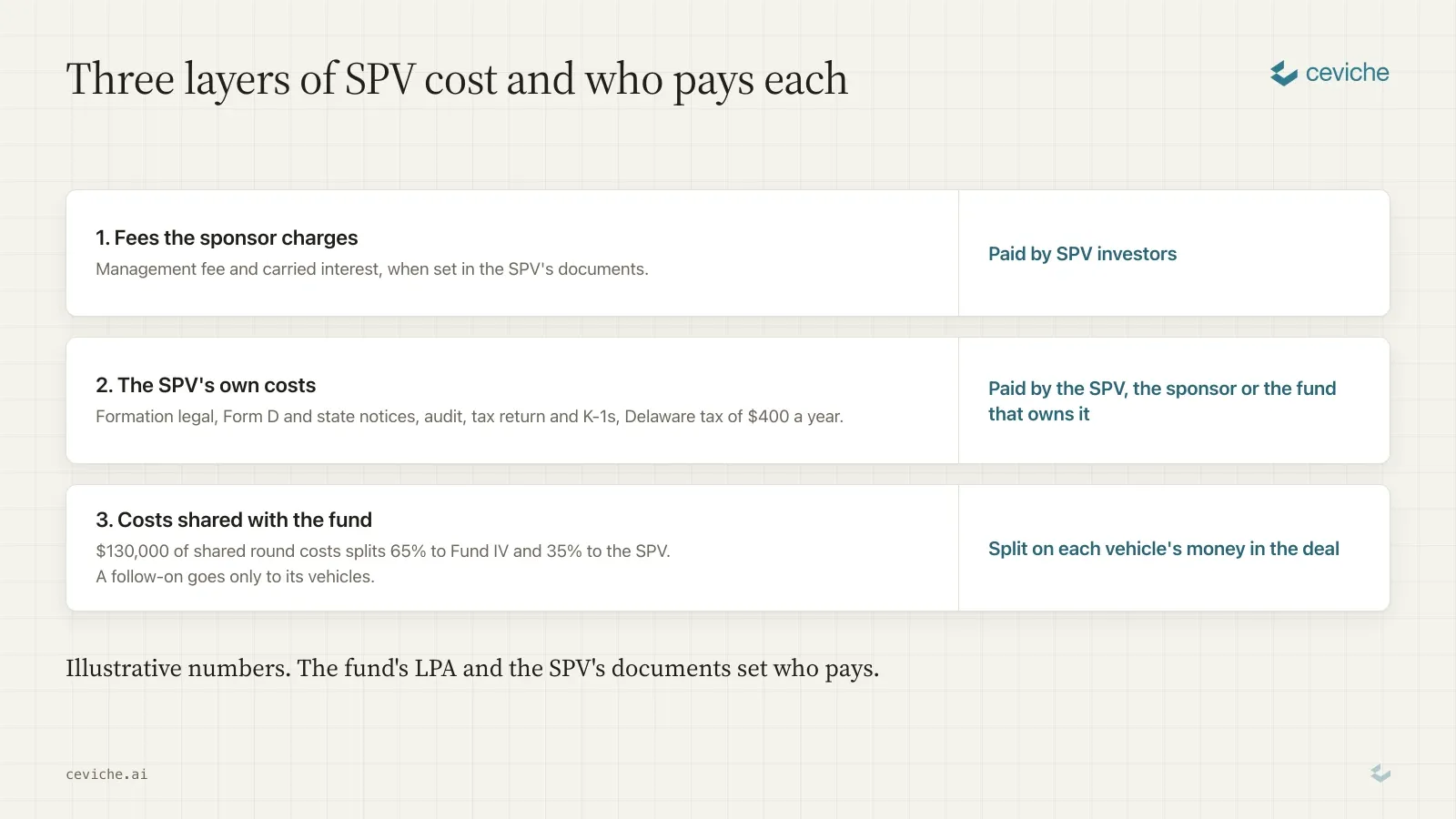
SPV fees and expenses come in three layers. The sponsor can charge SPV investors a management fee and carried interest. The SPV has its own costs for formation, filings, audit and tax returns. It also bears part of deal costs shared with the sponsor's fund, split on each vehicle's investment in that deal. The SPV's documents decide who pays.
SPV expenses are the costs of a special purpose vehicle formed for one investment. They include its formation, filings, administration, audit and tax returns, plus its part of deal costs shared with the sponsor's funds. The SPV's own documents decide which costs its investors bear, which the sponsor absorbs and how the shared costs are split.
What are the three layers of SPV cost?
An SPV is a separate entity, such as an LLC or a limited partnership, that makes one investment. Its costs fall into three layers.
- Fees the sponsor charges. A management fee and carried interest, if the SPV's documents set them.
- The SPV's own costs. Formation, filings, administration, audit and tax returns.
- Shared costs. The SPV's part of costs that it shares with the sponsor's funds, such as counsel on a round it joined.
A fund finance team meets two kinds of SPV. Some SPVs are owned by a fund and hold one of its investments. Others are co-invest SPVs, where outside investors buy into one deal next to the fund.
A domestic LLC or LP with two or more members is a partnership for tax unless it elects otherwise. Under 26 CFR 301.7701-3, such a domestic entity is "A partnership if it has two or more members." The Form 1065 instructions then require "a Schedule K-1 to Form 1065 for each partner." So every SPV with two or more members adds a set of books, a partnership return and a K-1 for each investor. Our guide to the books of every fund, SPV and management company covers the accounting side.
Structural vehicles carry costs too. The finance team at a private fund manager said that some vendors bill each quarter across every entity in the structure. Blockers, splitters and aggregator vehicles each get a share. Of the 80 fund finance teams we spoke with in 2026, 96% (77 of 80) cite multi-entity allocation as a core complexity.
Every SPV is one more entity that a single vendor invoice can touch. In Ceviche, every split comes from a rule that your team approved or from an allocation that a person on your team made.
What fees do SPV investors pay the sponsor?
The SPV's documents set the fees, such as a management fee and carried interest.
When the sponsor also runs a fund, ILPA addresses these fees. ILPA's Principles 3.0 say, "Unless prohibited by the LPA, a GP may charge management and other fees, such as transaction fees, on co-investments." They add, "Any management fees allocated on a pro rata basis to co-invest vehicles should accrue to the fund and be offset." That is ILPA's recommended practice. The fund's LPA sets what applies, and the offset arithmetic follows the fund's management fee offset terms.
Who pays an SPV's own expenses?
The SPV's documents decide. The payer can be the SPV's investors, through a reserve held back at the close. It can be the sponsor's management company. For an SPV that a fund owns, the fund above the SPV can pay.
The SPV's own costs include these lines.
- Formation legal. The SPV's operating agreement or LPA, the subscription documents and a review of the company's documents. A finance team member at a private investment firm said, "A lot of them are going to be startup costs."
- Form D. Under 17 CFR 230.503, the issuer files Form D "no later than 15 calendar days after the first sale of securities in the offering." This applies to offerings under Rule 504 or 506.
- State notice filings. For a Rule 506 offering, federal law lets a state require a filing "solely for notice purposes and the assessment of any fee."
- State tax. Delaware charges each LLC and LP an annual tax of $400.00.
- Tax return and K-1s. One partnership return a year and one K-1 for each investor.
- Audit. Some SPVs have one and some do not. The same team member said that some of their co-investment vehicles have the audit waived.
ILPA's Principles 3.0 say, "Organizational costs that are specific to an alternative vehicle, parallel vehicle, co-invest vehicle, etc. should be borne solely by that vehicle."
The CFO of a private equity firm said that the firm holds each investment in its own SPV, with the funds as its limited partners. That firm pays for an audit and a tax return for each SPV every year.
"So all that incremental flexibility for the investment performance ... side generates a lot more complexity around allocations."
A member of the team that approves expense allocations at a private credit manager described borrower-level SPVs. The master fund above the SPV pays any cost allocated to the SPV.
"...we always want anything allocated to the SPV to be paid by the master fund."
Our page on what the fund bears and what the management company bears covers the line above the SPV.
How do you split a deal cost between the fund and its SPV?
Split it on each vehicle's investment in that deal. But first pick the right entities. One private equity firm's finance team gave the rule. When a blocker holds the deal, its costs go to the blocker, not the upper-tier fund. Approvers who do not know the structure pick the wrong entity. The team calls this "a data input error, not an allocation error."
The ILPA model LPA also uses a deal-level methodology, based on capital committed to the co-investment. In section 9.3.3, the co-investor "shall bear its pro rata share (based on capital committed to such co-investment)" of fees and expenses for that investment. The model is a template that ILPA published as a starting point.
The percentages move with every deal and every follow-on round. The person who runs cost allocations at one fund manager often splits legal invoices on the co-investment size in each deal. That person said, "it's not a single fixed percentage each time." Counsel on a follow-on round goes only to the vehicles that invested in it.
Vehicle's share = shared deal cost x (the vehicle's investment in the deal ÷ all participating vehicles' investment in the deal)
Use each vehicle's investment in the deal on the date of the work. A cost that belongs to the SPV alone, such as its formation or its audit, is not split. The SPV's documents and the fund's LPA decide whether the SPV may bear a cost at all.
Overhead is a different case. A fund finance lead at a large fund manager splits insurance and software by commitment. That lead said, "every time we add a new fund, which we do, SPVs frequently, it changes the overall allocation by commitment." If the SPV's documents do not allow overhead charges, that share stays with the management company. Our guides to splitting a legal invoice across fund entities and allocation methods cover the mechanics.
The SPV may sit with a different fund admin than the funds. Whoever splits the vendor invoice needs each holder's investment in that company. The firm can split the invoice itself and send each fund admin its part.
What does one SPV deal cost each vehicle?
Take an illustrative Series B round of $20,000,000. Fund IV buys $13,000,000 of the shares, and a co-invest SPV with 24 outside investors buys $7,000,000. Every number here is hypothetical except the Delaware tax. The example leaves out administration fees.
The round has $130,000 of shared costs, $96,000 of outside counsel and $34,000 of diligence. Fund IV holds 65% of the round and the SPV holds 35%.
| Cost | Fund IV | SPV | Total |
|---|---|---|---|
| Shared counsel and diligence | $84,500 | $45,500 | $130,000 |
| SPV formation legal | $16,000 | $16,000 | |
| State notice filings | $1,800 | $1,800 | |
| First-year audit | $14,000 | $14,000 | |
| Tax return and 24 K-1s | $7,200 | $7,200 | |
| Delaware annual tax | $400 | $400 | |
| Year one total | $84,500 | $84,900 | $169,400 |